Why Choosing the Right Type of Paper Matters
Many people are used to relying on small-roll toilet tissue for every purpose — wiping their face, mouth, hands, or even lining food — simply because it's easy to find and inexpensive. In reality, however, toilet tissue is designed specifically for cleaning after using the restroom. Its key properties are being suitably soft and breaking down well in water, so it doesn't clog drains.
Using toilet tissue for the wrong purpose can lead to:
- Using more paper than necessary (toilet tissue breaks down easily when wet, so more sheets are needed compared to facial tissue)
- A higher risk of microbial contamination, since toilet tissue isn't held to the cleanliness standards required for contact with food or the face
- Conversely, flushing facial tissue or multi-purpose paper down the toilet can clog pipes, since these types aren't designed to break down in water
5 Types of Tissue Paper and Their Key Properties
Toilet Tissue
Used specifically for cleaning after using the restroom. Soft and breaks down well in water. Available as jumbo rolls (JRT) for offices and public spaces, or small rolls for home use.
Facial Tissue
Sheets in a rectangular box. Must be soft, free of paper dust, and strong enough not to tear when wet. Designed for the face or makeup removal — gentler than paper for other body parts.
Napkins
Common in restaurants, hotels, and dining establishments. Similar to facial tissue but stronger and more resistant to breaking down when wet, to hold up during meals.
Hand Towels
Found in public restrooms, hospitals, hotels, and malls. Strong, wet-resistant, and highly absorbent — designed for continuous, high-frequency use rather than softness.
Kitchen Towels
Similar to two-ply toilet tissue but thicker. Used mainly in the kitchen for wiping messes or absorbing frying oil. Must be especially thick and highly absorbent.
Feature Comparison Table
| Property | Toilet Tissue | Facial Tissue | Napkins | Hand Towels | Kitchen Towels |
|---|---|---|---|---|---|
| Cleanliness | ✓✓ | ✓✓✓ | ✓✓ | ✓ | ✓✓✓ |
| Strength | ✓ | ✓✓✓ | ✓✓✓ | ✓✓✓ | ✓✓✓ |
| Softness | ✓✓ | ✓✓✓ | ✓✓ | ✓ | ✓ |
| Thickness | ✓ | ✓✓ | ✓✓ | ✓✓ | ✓✓✓ |
| Breaks Down in Water | ✓✓✓ | ✓✓ | ✓ | ✓ | ✓ |
| Durability | ✓ | ✓✓ | ✓✓ | ✓✓✓ | ✓✓✓ |
How to Check Whether Paper Is Made from Virgin or Recycled Pulp
Recycled paper that has been bleached often contains optical brightening agents (OBAs) to make the paper appear whiter and cleaner — which, with regular skin contact, may not be safe for long-term health. Here are simple ways to check at home:
The Water Test
Dampen the paper with water and let it sit for a moment. If the paper turns black or dark spots appear, it indicates recycled paper that has previously been bleached.
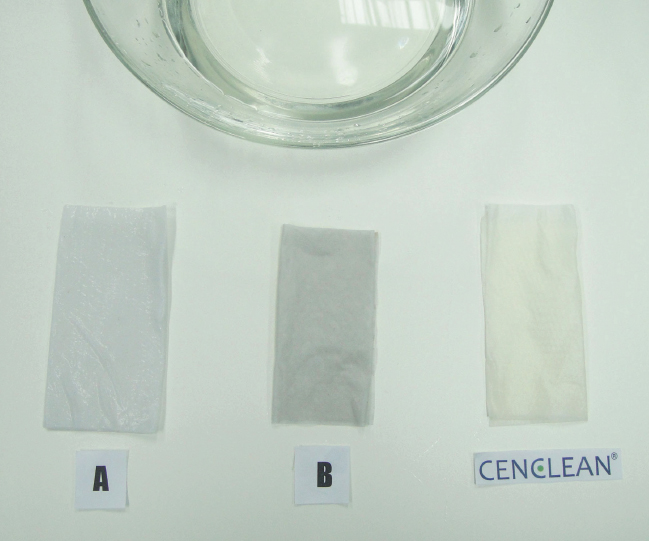
Water test result — CENCLEAN paper (right) shows no color change, while Brand A and Brand B (left) develop a murky grey residue
The UV Banknote-Detector Test
Paper containing optical brighteners will glow blue under UV light (such as a banknote detector), while paper made from 100% virgin pulp will show no such glow.
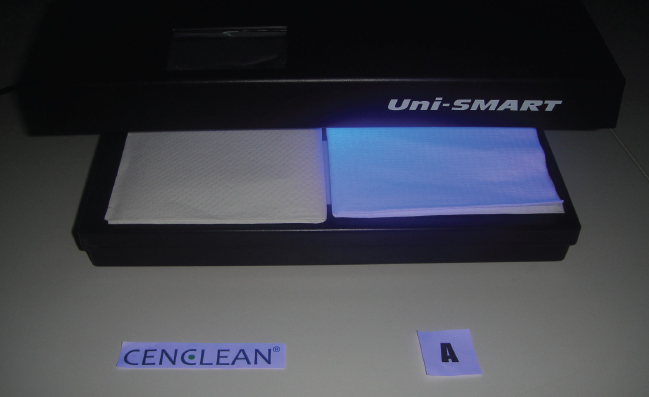
UV test result — Brand A paper (right) glows visibly blue under UV light, while CENCLEAN paper (left) shows no glow
The Hidden Danger of Optical Brightening Agents (OBAs)
Findings from Thailand's Department of Science Service
According to research published in the Department of Science Service Journal, optical brighteners are water-soluble chemicals structurally derived from stilbene — a compound whose molecular shape resembles the female hormone estrogen. If absorbed by the body in significant cumulative amounts, stilbene derivatives may affect fetal development or impair sexual function in men. When hygiene paper containing OBAs is used to clean the skin, residue may trigger allergic reactions. Research has also found that when OBAs are exposed to UV radiation (wavelength 254 nm), they may induce skin-carcinogenic compounds.
Interestingly, several countries — including Germany and Japan — require food-grade paper packaging to be tested and certified free of optical brighteners. Thailand currently has no such mandatory regulation, which leaves the choice of OBA-free products as a responsibility shared by manufacturers and consumers themselves.
1. Phuwadee Tujinda and Korpong Hongsri. "Optical Brighteners in Paper Products: The Hidden Danger Behind the Whiteness." Department of Science Service Journal. Department of Science Service, Ministry of Higher Education, Science, Research and Innovation, Thailand. pp. 10–11.
2. FALK, Hans L., and E. BINGHAM. "Interaction of fluorescent whitening agents and ultraviolet radiation." AMBIO. 1973, 2 (1/2), 22–25.
CENCLEAN Chooses to Manufacture from 100% Virgin Pulp
🌿 Why CENCLEAN Uses 100% Virgin Pulp
- No optical brightening agents (OBAs) and no foreign odor
- Strong paper texture with good water absorption
- Breaks down well in water, won't clog pipes — ideal for high-volume jumbo roll tissue use
- FSC® (Forest Stewardship Council) certified for sustainable forest management
Choosing the right type of paper not only maximizes effectiveness in use, but also reduces hidden long-term costs while being environmentally friendly at the same time.
Looking for Quality Tissue Paper for Your Organization?
If your organization needs quality toilet tissue and hand towels for hotels, hospitals, offices, or factories — the CENCLEAN team is ready to provide free consultation and a quote.